
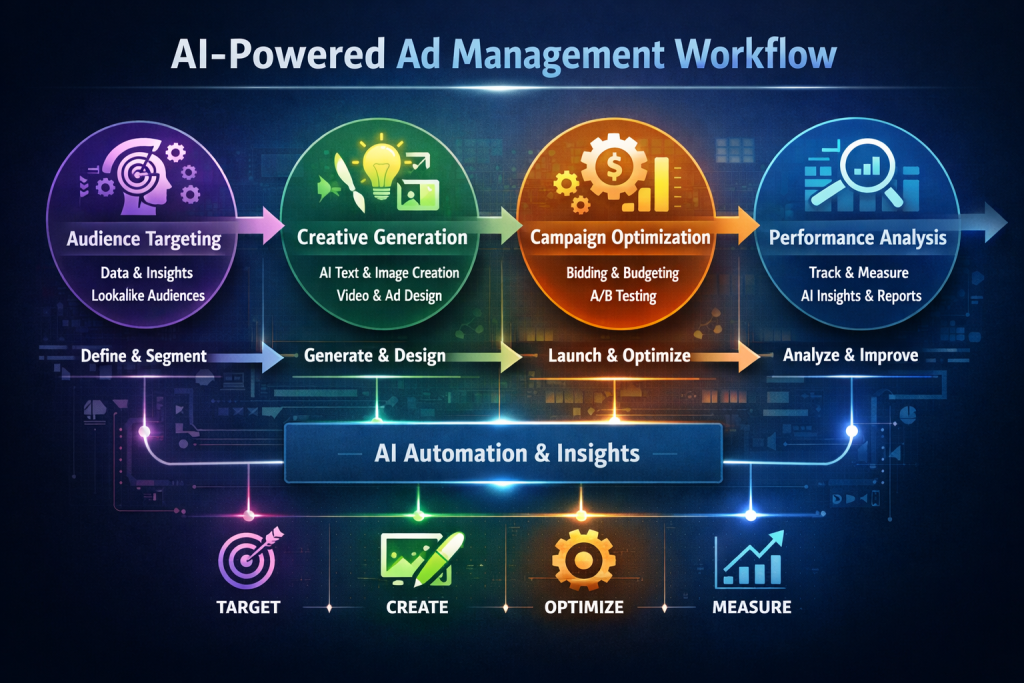
AI-powered ad management tools help marketers plan, produce, optimize, and scale paid campaigns by using machine learning and generative AI to automate repetitive work (like variant creation, audience building, and performance recommendations). The big caveat: “ad management” can mean very different things—some tools focus on creative generation, others on campaign optimization, and others on audience targeting—so the best choice depends on which part of the ad lifecycle you need to improve most.
Evercopy AI
How it works: Evercopy focuses on generating and scaling ad creatives (banners, product images, and video ads) quickly, and it emphasizes keeping output on-brand by extracting brand elements from a URL or references.
Best for: Agencies and brands that need high-volume creative production and variations more than hands-on bidding, budget automation, or deep media-buying controls.
Pros
- Strong “creative factory” positioning for producing many ad variants fast.
- Brand-consistency features that auto-pull logos/colors/fonts from a URL.
- Built-in editor for refining and adapting generated assets.
Cons
- Primarily a creative generation tool, not a full campaign management console.
- Pricing details are not consistently published on the vendor site (often easier to find via third parties).
Pricing (USD)
- Third-party pricing lists plans starting around $49/month (with credit-based tiers). Source
AdCreative.ai
How it works: AdCreative.ai generates on-brand ad creative variations from templates (or custom templates), supporting rapid A/B testing by producing multiple versions and helping you iterate toward what performs.
Best for: Performance marketers and small-to-mid teams that want fast, template-driven creative iteration across many formats without adding headcount.
Pros
- High-volume creative generation across sizes/variations.
- Clear A/B testing-oriented workflow (generate many, keep winners).
- Widely adopted (vendor claims millions of businesses).
Cons
- Skews creative-first; it’s not trying to be a full optimization suite for budgets and bidding.
- Output quality still depends heavily on inputs (brand rules, offers, product positioning), so you’ll want human review.
Pricing (USD)
- Third-party listings commonly report Starter $39/mo, Professional $249/mo, Ultimate $599/mo. Source
Adzooma
How it works: Adzooma is a cross-platform management and optimization layer for paid ads, positioning itself around AI-driven insights and recommendations, and it supports managing campaigns across major ad platforms in one place.
Best for: Agencies and marketers running multi-account PPC who want a unified view plus guided optimization suggestions.
Pros
- Centralizes management across ad platforms (commonly positioned around Google/Microsoft/Facebook connections).
- Recommendations refresh cadence varies by plan (monthly/weekly/daily), which can matter for fast-moving accounts.
- Strong fit for reporting and “what should I fix next?” workflows.
Cons
- The “AI” here is primarily recommendations and insights, not end-to-end autonomous buying.
- The more value you want (fresh insights, more automation), the more you’ll likely need paid tiers.
Pricing (USD)
- Vendor lists Free ($0) plus paid tiers Silver ($69/mo) and Gold ($179/mo).
Omneky
How it works: Omneky combines AI creative generation with performance/insight layers like creative analysis, forecasting, and budget planning, with some plan-specific channel limitations (for example, “Meta only” insights in certain tiers).
Best for: Teams that want creative + analytics/insights in one platform, especially if they’re heavy on Meta and want structured creative learning loops.
Pros
- Offers creative insights and scoring workflows intended to improve performance before launch.
- Multi-channel ambitions (Meta plus other networks are referenced in higher tiers).
- Case-study style proof points are prominent (ROAS, revenue, CPA/lead-cost improvements).
Cons
- Some capabilities are plan-restricted (example: “AI creative insights and recommendations (Meta only)” on the Pro tier).
- Credit-based generation can make heavy testing expensive if you’re producing lots of variants.
Pricing (USD)
- Published pricing includes Standard $29/mo, Pro $99/mo, Ultra $249/mo, plus Enterprise (custom).
Optimyzee
How it works: Optimyzee positions itself as an AI tool to quickly structure and optimize Google Ads search campaigns “from scratch,” with plan limits tied to spend and the number of campaigns it will optimize/publish.
Best for: Solo consultants and small agencies that want faster Google Search campaign creation and templated optimization without the cost of enterprise PPC platforms.
Pros
- Clear Google Ads focus, with workflow designed to go from idea → campaign quickly.
- Low entry pricing with a free tier for testing.
- Spend/campaign limits make it predictable for smaller accounts.
Cons
- Not a broad cross-channel tool; it’s mainly for Google Search workflows.
- Plan limits (spend caps, publications per month) can be restrictive as you scale.
Pricing (USD)
- Published plans include Free ($0) and Business ($29/mo), with higher tiers listed on the pricing page (e.g., Professional).
Mintly
How it works: Mintly is primarily an AI ad creative generator that emphasizes rapid production of image/video ads, with features like cloning concepts from existing ads (positioned around “ad library cloning”) and scaling output through brand kits and credits.
Best for: Ecommerce operators (Shopify/Amazon/TikTok Shop-style sellers) and lean teams that need more creatives per week without agencies.
Pros
- Clear “scale creative fast” proposition with defined monthly output limits (ads/month).
- Plan structure is straightforward for small teams (brands/users/credits).
- Good fit when your bottleneck is creative volume, not bidding strategy.
Cons
- Like most creative tools, it won’t replace media buying rigor (budget pacing, attribution nuance, incrementality).
- Best results still require strong product positioning, offers, and guardrails for brand compliance.
Pricing (USD)
- Published pricing includes Starter ($19/mo shown on annual-equivalent display), Growth, and higher tiers with specific ad/month limits.
Proxima AI Audiences
How it works: Proxima’s AI Audiences uses machine learning and commerce insights to build predictive lookalike-style audiences for paid social, aiming to target shoppers most likely to purchase and scale profitably.
Best for: Consumer brands (especially ecommerce) that want a targeting edge for paid social and need audience engineering more than creative generation or campaign ops tooling.
Pros
- Clear targeting focus: predictive audiences designed to improve paid social performance.
- Publicly offers a 30-day free trial with no credit card required.
- Strong testimonial-style proof points on outcomes and targeting value (especially around Meta targeting).
Cons
- It’s not a full ad management suite; it mainly solves the audience/targeting layer.
- If your primary problem is creative fatigue or account structure, you’ll still need complementary tools.
Pricing (USD)
- Proxima does not prominently publish paid pricing on the AI Audiences page (beyond the trial).
- A credible third-party listing reports a Starter plan around $1,000/month (treat as directional until confirmed by Proxima). Source
Conclusion
The headline finding from researching these tools is that “AI ad management” is really three different categories wearing one label:
- Creative scaling engines (Evercopy, AdCreative.ai, Mintly) for producing more variations faster.
- Optimization and workflow layers (Adzooma, Optimyzee) for recommendations, reporting, and streamlined PPC execution.
- Targeting intelligence (Proxima AI Audiences) for improving who you reach, not necessarily what you show them.
For sophisticated marketers, the best stack is often modular: pair a creative generator with either a PPC optimization layer or an audience engine, then decide where humans stay “in the loop” (brand safety, offer strategy, measurement). In 2026, the advantage isn’t just using AI—it’s choosing which part of the ad lifecycle to automate, and measuring whether that automation actually improves outcomes.
Note: ChatGPT was used to assist with the research for this post.