
Contributed post.
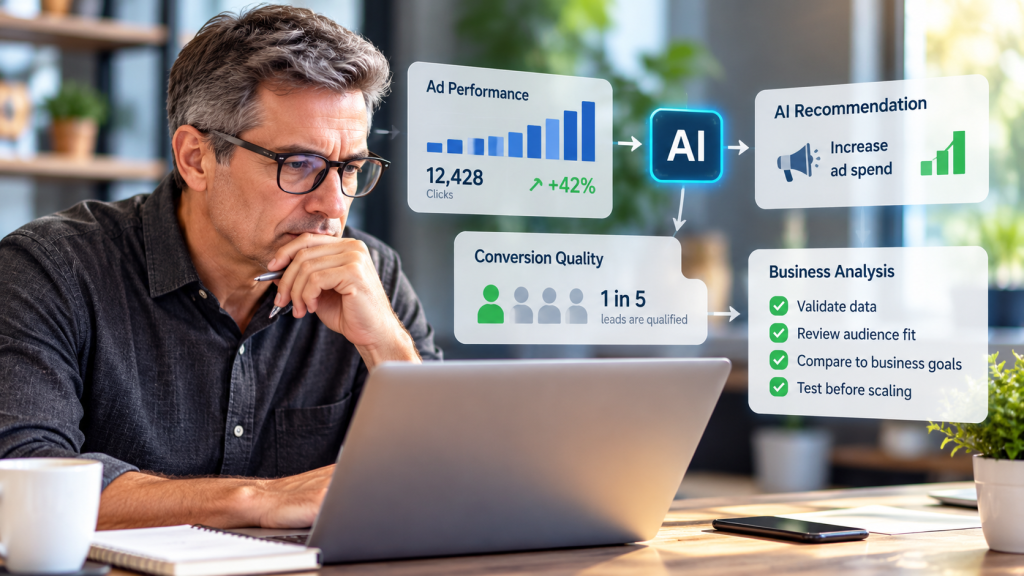
Imagine a software company running an ad that starts getting a lot of clicks. Its AI tool suggests spending more money on the ad because people are clicking on it. But the sales team finds that only a few people who contact the company actually need its product.
This is one simple example of why AI marketing decisions need a closer look. A high number of clicks or high CTR doesn’t always lead to more sales. Business analysis in marketing helps teams see what is working and what needs to change. By checking campaign data, business goals, and customer responses, teams can decide whether suggestions from AI marketing tools are worth following.
Business analysis connects AI insights with business needs
Teams can check a recommendation with business analysis before deciding what to do.
Identify the problem behind the numbers
Business analysis in marketing starts with understanding a business need, considering possible solutions, and deciding how to measure success.
AI may identify an ad that attracts more visitors. An analyst checks whether those visitors have a need the company can meet.
For the software company, the problem is not a lack of attention. Many inquiries come from people who are unlikely to use its product.
Investigate possible reasons before choosing an action
Business analysis for AI marketing helps teams check whether an ad reaches the right people. For example, an ad may attract people looking for small business software, even though the product is made for enterprise business teams. Understanding that mismatch gives the team a specific issue to address.
Clear goals give AI marketing decisions a useful direction
A clear goal helps teams judge recommendations against an agreed business outcome.
Agree on what a suitable lead means
Marketing may call every form submission a lead, but the sales team may not agree. They may only count people who are likely to buy the product and meet BANT qualifications (budget, authority, need, and timeline).
Both teams should agree on a suitable lead definition. For this company, that could include a relevant business need, company size, and service location.
Use the goal when comparing campaigns
Aligning AI marketing with business goals means checking whether a campaign brings the right results. An ad may get fewer clicks but bring in more people who want a product demo. In that case, fewer clicks may be a better result than a large number of visitors.
Reliable data makes campaign analysis more useful
AI marketing analytics works well when the data is correct, and no important details are missing.
Check records before accepting a recommendation
Before spending more on ads, check the records, same inquiry may appear twice, making the results look better than they are. If sales updates are missing, it may also be hard to tell which leads turned into customers.
| Data problem | What it affects | How to check it |
| Duplicate inquiries | Lead numbers may look higher than they are | Look for repeated contact details |
| Missing sales updates | The team may not know which leads moved forward | Check the latest status with sales staff |
| Different conversion rules | Reports may show different results | Use the same rules for every campaign |
| Old records | Results may not match current customer needs | Check the dates, audience, and offer |
Use information that answers the business question
In marketing, it is essential to analyze the relevant metrics. For the software company, it is more important to evaluate which sources of inquiries result in sales rather than the number of ads displayed
Business context helps teams question AI recommendations
Before following an AI suggestion, check the numbers behind it and what was happening when the results came in.
Check what the recommendation actually measures
Campaign measures describe different actions:
- Clicks show that someone opened an ad link.
- Form submissions show that someone shared information.
- Qualified leads meet agreed business requirements.
- Paying customers have completed a purchase.
Clicks alone do not indicate which ad attracted a buyer; teams must investigate what happens when an inquiry is made.
Consider what campaign reports may leave out
Slow sales follow-up could leave interested prospects waiting. Seasonal demand could change response levels, while an unqualified audience could explain weak inquiries.
The team also needs enough people to handle new demo requests. If staff are busy, customers may have to wait for a reply.
Small tests help teams decide what to change
A limited test helps the company investigate whether clearer wording attracts more suitable prospects.
Plan a focused campaign test
Before making a change, the team should note what it plans to do, what it hopes to achieve, and how it will check the results.
Change one main element
Test a message that clearly states the software’s business use. Keep the audience, offer, and spending similar where possible so other changes do not confuse the comparison.
Define success before testing
First, decide what counts as a good result, such as demo requests from the right customers. Note the current numbers and set a date to check the results again.
Allow time for sales follow-up
Staff need time to contact inquiries and record outcomes. A few responses provide little basis for a confident judgment.
Fewer clicks alongside more suitable leads could support the revised message. An unclear result may require further testing.
Business outcomes show whether the decision worked
Measuring AI marketing campaign results means returning to the original goal and checking whether inquiries progressed.
Follow results beyond the first response
Teams should track a few key results:
- Demo requests from potential customers
- Leads that sales considers suitable
- Leads that turn into customers
- Sales revenue compared with ad costs
AI marketing analytics helps teams keep these numbers in one place. For a fair comparison, use the same rules and time period for each campaign. Give new leads enough time to become customers before comparing them with older leads.
Use the findings to guide the next action
A sale following an ad interaction does not prove that the ad caused it. Earlier conversations or other marketing activity may have contributed.
This explains how business analysis improves marketing decisions. Teams review outcomes, recognize limits, and use the findings to decide what deserves further action.
Conclusion
The software company marketing team first looked at clicks, but that did not tell the whole story. The team had to check who was interested, whether those people needed the product, and how many inquiries led to sales.
These details help with AI marketing decisions. Before spending more money on a campaign, the team can try a small change and check what happens. If the results are solid and the data is reliable, increasing the budget may make sense.
Anannya K is a content writer at SterlingNext who covers business processes, quality management, and workplace practices. Her articles explain complex topics in simple language, using practical examples to help readers understand problems and make informed decisions.